
1 · Register
Agent Hub
OAuth identity, delegation, discovery — every agent becomes a governed subject with an accountable owner.
Always-on AI teams on your identity fabric — heartbeats that detect issues, team charters that divide the work, confirmation gates that pause for a human, and proof for every permitted step.
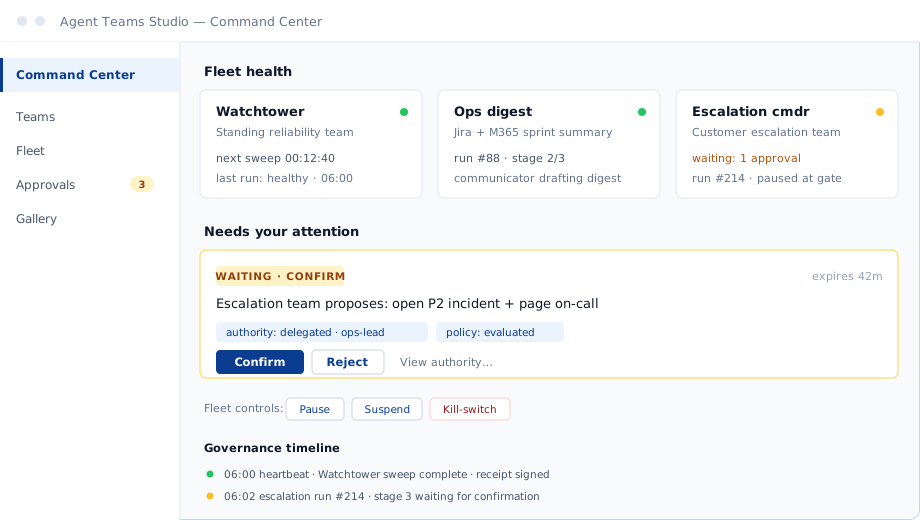
Agent Teams Studio Command Center showing standing teams, a waiting confirmation, and fleet pause, suspend, and kill-switch controls.
Most agent deployments are reactive: a human opens a chat, asks a question, and hopes the agent remembers context next time. Security teams see API keys, broad tool access, and no kill switch. Operations teams see overnight failures and escalations that arrived too late.
Agent Teams inverts the model: proactive, scheduled, governed autonomy — agents that monitor on a cadence, surface issues with context, hand off between roles in a team charter, and stop at confirmation gates before high-risk actions.
The model proposes, the platform decides, humans confirm, auditors verify.
| Reactive AI agent | EmpowerID Agent Teams |
|---|---|
| Waits for a user prompt | Heartbeat scheduler — configurable, always-on checks |
| Session amnesia | Team workspace + charter — persistent governed state |
| One agent, one thread | Multi-agent teams — roles, runs, staged handoffs |
| Guardrails optional | Confirmation-native — execution waits before risky actions |
| Opaque logs | Governance timeline in Agent Teams Studio |
| Developer API keys | Delegation-scoped identity — same spine as your people |
| No emergency stop | Pause, suspend, kill-switch on every agent |
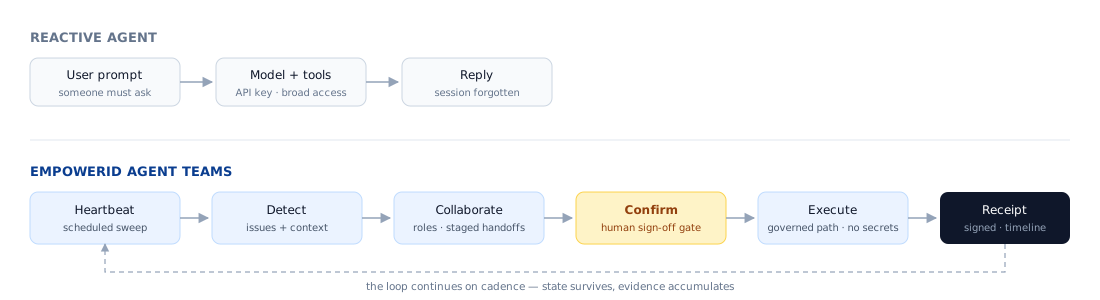
Agent Hub gives an agent a badge. Agent Teams gives it a shift, a crew, and a supervisor sign-off.
1 · Register
OAuth identity, delegation, discovery — every agent becomes a governed subject with an accountable owner.
2 · Deploy
Start from a template, define the team charter — roles, systems, approval model — and set the cadence.
3 · Operate
Heartbeats, runs, approvals, collaboration, receipts — with fleet health and stop controls in one desk.
Four capabilities, one platform — each enforced by the runtime, none delegated to a prompt.
In Agent Teams, the model produces content — drafts, classifications, summaries, plans. The platform owns the operating state: schedules, stage advancement, schema validation, approvals, retries, receipts. A probabilistic model is never the authority over what runs next.
That's the difference between an agent framework where the model drives control flow unchecked — and an operations platform your security team can defend. Model behavior can evolve without changing what waiting, approved, failed, or stopped means.
| The model contributes | The platform owns |
|---|---|
| Interpret a sweep; summarize exceptions | Schedule and lease state; run + stage identity |
| Classify severity; propose a plan | Contracts, schema validation, team authority |
| Draft the escalation a human approves | Confirmation status; retry rules; handoffs |
| Select among policy-permitted next steps | Terminal state; receipts; pause / suspend / kill |
Agent Teams doesn't re-implement governance inside a prompt. Model calls go through the LLM Gateway, tool calls through the MCP Gateway, execution through the Orchestration Service — the same identity, policy, credential, and evidence services that govern your workforce.
Model calls
Every model invocation authorized first — identity, delegation, intent, budget.
Learn more →Tool calls
Governed tool discovery and execution — schema integrity, parameters, delegated access.
Learn more →Execution
Native enterprise work under confirmation gates; device-level steps run signed envelopes with the same governance trail.
Learn more →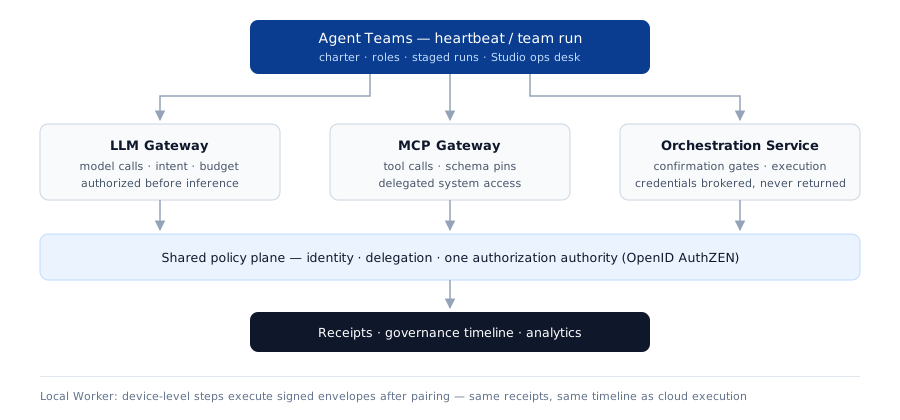
Agents receive data, never OAuth secrets — downstream credentials are brokered by the execution path.
Watchtower template monitors platform health on a heartbeat — every sweep is a governed run with provenance.
Multi-system customer escalation: detect → brief → plan → confirm → act, with a human at the consequential step.
Scheduled team run summarizes Jira and M365 sprint state and posts the digest — template-driven, charter-bound.
Ambiguous identity resolution becomes a waiting task on the same spine as IGA — not a separate agent stack.
Conversational app builders make chat experiences inside one suite. Developer agent loops run on personal trust and API keys. Agent Teams runs cross-system, governed operations — and it's built on the identity platform that already governs your workforce.
Download the Comparison GuideAlways-on heartbeats — scheduled operations, not session-bound chat.
Team charters with graph authority — not ad-hoc multi-agent prompts.
Confirmation gates at the platform boundary — not in-process guardrails a prompt can route around.
Dual enforcement points — model and tool calls governed separately on one policy plane.
Every control your security team will ask about is a platform property, not a prompt instruction — and every one of them is revocable, auditable, and testable.
| Property | What it means for you |
|---|---|
| Delegation-scoped agents | Authority narrows and expires — revocable like any human grant |
| Zero token return | Agents receive data, not OAuth secrets |
| Kill-switch / pause / suspend | Emergency stop without redeploying — recorded, authorization-protected |
| Inbound channel pairing | Telegram/email senders approved before any tool runs |
| Analytics trail | Operational telemetry and receipts feed the same evidence path as human access |
See heartbeat scheduling, team charters, confirmation gates, and the governance timeline in a live demo.

Online
Powered by EmpowerID AI