EmpowerID Identity Fabric · LLM Gateway

Every AI call. Authorized first.

Copilots and agents don't get model access with an API key. The EmpowerID LLM Gateway checks who is asking, under whose authority, for what intent, within what budget — before the provider is called — and signs the evidence.

OpenAI- and Anthropic-compatible routes · Multi-provider control · AuthZEN-compatible policy

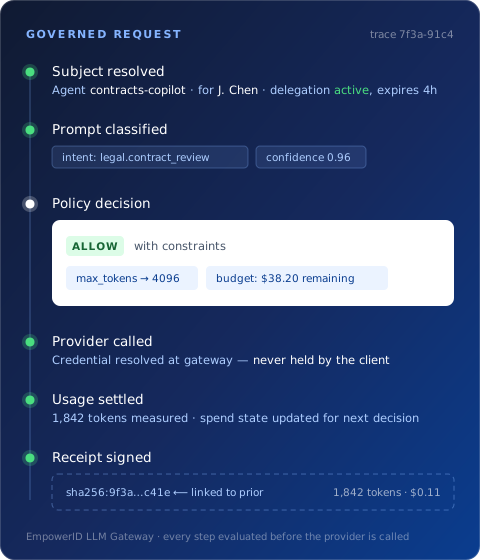
Governed request trace showing an allowed path before provider consumption.

AI applications move fast. Their controls rarely move together.

Teams can connect a copilot or agent to a model in hours. Production governance is harder. Who is making the request? Is an agent acting for a person — and is that delegation still active? Does the prompt indicate sensitive intent? Is the model approved for this subject? Has the budget been reached? Which policy allowed the call?

Generic API keys, per-app guardrails, and after-the-fact dashboards answer fragments. The EmpowerID LLM Gateway brings them into one runtime authorization decision at the model boundary.
One governed decision before provider consumption

Know who—or what—is calling

Evaluate model access for people, applications, workloads, and AI agents using Identity Fabric sessions or personal access tokens. For agents, policy considers the identity chain and active delegated authority—not possession of a shared model key.

Turn prompt context into policy context

Only allowlisted, high-confidence labels cross the policy export boundary. The classifier supplies context; the PDP makes the decision. Safety guards configured as mandatory fail closed when classification is unavailable.

Make spend part of authorization

Evaluate current AI budget state before the upstream model request. Policy can deny a call, constrain requested tokens, or select a lower-cost allowed model before provider charges are incurred.

Keep provider credentials out of clients

Applications authenticate to the Identity Fabric. Organization-managed provider credentials are resolved at the gateway and injected only on the upstream provider connection.

Preserve evidence of allowed use

For completed allowed calls, create signed, hash-linked receipts that bind policy context to measured usage. Denied calls generate decision and operational telemetry—not signed receipts.

Route across providers — under policy

Multi-provider routing, circuit breaking, and failover — with alternatives constrained by model policy, so an availability event never becomes an authorization exception.

The governed model path

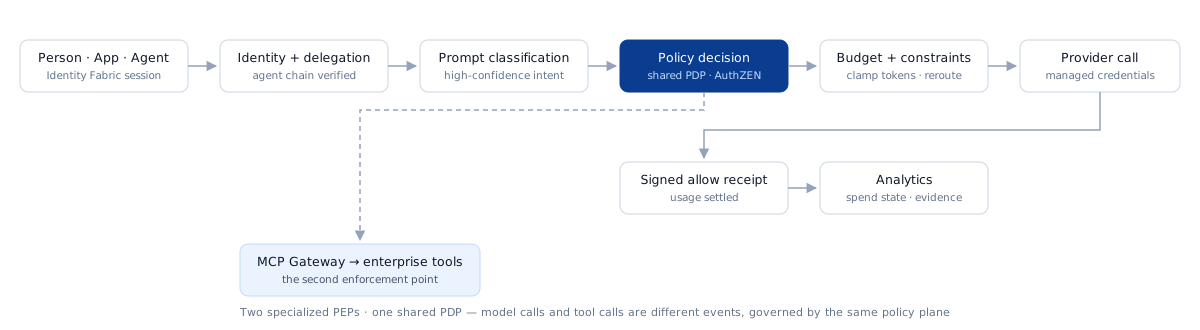
Every governed request runs the same deterministic sequence — even when the policy itself is context-sensitive.

Authorization is not a wrapper around inference. It is the decision that determines whether inference should occur.

  1. 1

    Authenticate the subject

    Resolve the person, application, workload, or agent — and its identity chain.

  2. 2

    Classify the request

    Derive selected intent, safety, and data context from the prompt.

  3. 3

    Ask for an authorization decision

    Send subject, model, action, classification, delegation status, estimated cost, and context to the policy decision point.

  4. 4

    Enforce constraints before inference

    Allow or deny, clamp maximum tokens, or route to another permitted model.

  5. 5

    Call the provider securely

    Resolve the organization-managed credential and relay the compatible request.

  6. 6

    Settle measured usage

    Capture available provider usage and update the governed spend path.

  7. 7

    Create evidence

    Emit a signed receipt for the completed allowed call and send it to analytics.

Governed model path including classification, PDP decision, provider call, and evidence.

More than an LLM proxy

Most AI gateways begin with connectivity: one endpoint, multiple providers, traffic logs, retries, rate limits. Useful — and incomplete. Production agents create an authorization problem. The EmpowerID LLM Gateway connects model traffic to the Identity Fabric's shared truth about identity, delegated authority, policy, and evidence.

Conventional gateway questionIdentity Fabric question
Is this API key valid?Which governed subject is acting, and for whom?
Is the route allowed?May this subject use this model for this intent now?
Has the request rate been exceeded?Is current spend within the policy boundary for this user, agent, or application?
Did the request succeed?Which decision authorized it, what constraints applied, and what usage followed?

One policy plane. Two specialized enforcement points.

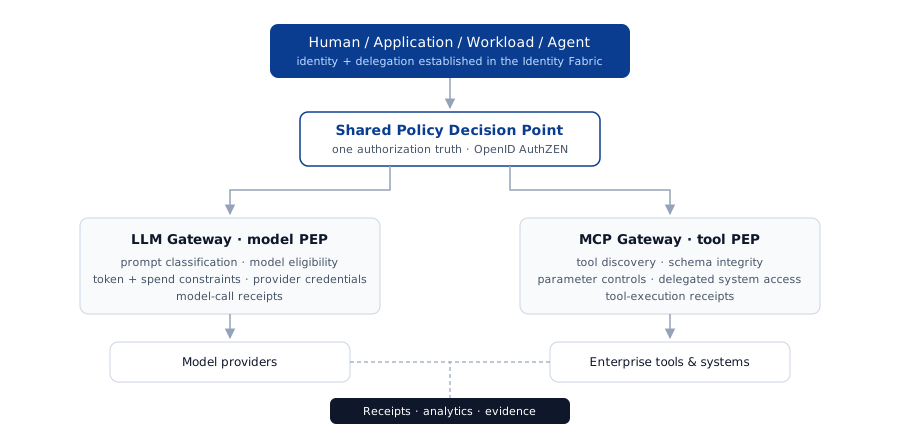
AI agents cross two different boundaries. Both enforcement points use the Identity Fabric's shared policy and identity context — without pretending that generating language and executing a consequential tool are the same kind of event.

LLM Gateway · model boundary

Governs model invocations

  • Prompt classification and intent labels
  • Model eligibility and delegated authority
  • Token and spend constraints
  • Provider access and streaming semantics
  • Model-call evidence

MCP Gateway · tool boundary

Governs tool execution

  • Tool discovery and schema integrity
  • Parameter controls
  • Delegated access to enterprise systems
  • Downstream credential brokering
  • Tool-execution evidence
Explore the EmpowerID MCP Gateway
Shared policy decision point with LLM and MCP enforcement points.

Built for the teams responsible for production AI

Security and IAM

  • Extend identity-aware policy to model access
  • Require active delegation for agent subjects
  • Reduce reliance on shared provider secrets
  • Apply consistent controls across people, applications, and agents
  • Trustworthy failure semantics when dependencies are unavailable

AI platform and application teams

  • Preserve familiar OpenAI- and Anthropic-compatible request patterns
  • Centralize provider connectivity and credential management
  • Separate policy logic from individual applications
  • Multi-provider routing, circuit breaking, and policy-permitted failover
  • Response signals when the effective model differs from the requested one

FinOps

  • Attribute model use to governed subjects
  • Enforce policy before a provider call—not only report spend later
  • Constrain tokens based on policy
  • Permit lower-cost model alternatives where business rules allow

Risk and audit

  • Link completed allowed use to a policy decision
  • Retain signed, hash-linked evidence with honest deny semantics
  • Investigate model activity through centralized analytics
  • Support continuous control processes without claiming compliance by technology alone

Adopt governance without rewriting the application

The LLM Gateway exposes provider-compatible routes for common OpenAI and Anthropic request patterns. Applications authenticate through the Identity Fabric and point their SDK at the governed endpoint—the request body can remain unchanged while authorization, credentials, provider selection, budget policy, and evidence move into a shared control layer.

View integration documentation

Designed for control under failure

Governance is defined by failure behavior as much as by the happy path. The gateway avoids silently bypassing policy when the decision service is unavailable; budget enforcement can fail closed when authoritative spend state cannot be established for a limited subject; circuit breakers and failover support resilience without turning an outage into an authorization exception. Configuration and last-known-good behavior are selected to match the organization's risk and availability requirements.

Where teams start

Govern enterprise copilots

Give internal copilots controlled access to approved providers and models without distributing provider keys to each application or browser client.

Control agent model consumption

Require an active identity chain and delegated authority before an agent invokes a model, then attribute usage to the governed subject.

Enforce intent-aware data policy

Use high-confidence prompt labels as policy inputs to distinguish a permitted general business question from a restricted request about an individual or protected data.

Stop spend before it happens

Evaluate current budget state before provider consumption, constrain requested tokens, or route to a lower-cost allowed model under policy.

Create reviewable evidence

Bind completed allowed model use to signed receipts and analytics so investigators can reconstruct the decision, constraints, effective model, and usage path.

Read the whitepaper

"Authorization Before Inference" — the full architecture, lifecycle, and evaluation checklist.

Download

Frequently asked questions

Feature availability—including prompt classification depth, budget enforcement modes, model switching paths, provider routes, receipt coverage, circuit breaker behavior, and edition packaging—varies by release and deployment. Confirm scope with EmpowerID before customer-specific commitments.

Put identity and policy in front of inference

Watch a governed subject blocked by policy before the provider is called—sensitive intent flagged, a budget stop enforced pre-request, and the signed receipt trail for the calls that were allowed.

EmpowerID AI

EmpowerID AI Assistant

Online

EmpowerID AI
EmpowerID AI
Hello! How can I help you today?
07:33 PM

Suggested questions:

Powered by EmpowerID AI